

I Always Found Trouble – Because I Was Looking For It!
There I was again – peering into the quiet corners of my life like a detective with too much coffee and not enough evidence. Was that a flutter in my chest? A ghost note of memory I couldn’t quite place? An itch on my back – what could it be?! Wait! Is it getting worse? What’s that twinge? Let the spiral begin.
When Symptoms Become Stories
For years now I’ve had a parade of symptoms that would make me worry and wonder if something horrible was wrong with me: memory lapses that turned conversations into fog, heart palpitations at the strangest times, a brain that sometimes felt like a browser with 37 tabs open (well that was nothing new really), and random body rebellions that included everything but the classic hot flash (the universe decided to skip that trope for me). I described my symptoms, one by one, to my doctor. She sent me for cardiac tests. And then more. Ultrasound. Stress tests. Every test came back waving little flags of “You’re actually fine.” My heart, it turned out, was a model citizen.
At home, however, the cheerleading squad for catastrophe continued. I’d try to discuss this symptom or that to my mother and sisters. They’d look at me like I was being silly, chuckle and say, “Welcome to menopause!” like it was a surprise party I didn’t remember I was invited to. Not helpful, but comforting in that whole “we’ve all been there” way – but maddening too. The problem wasn’t the laughter. The problem was that no one gave me the heads up! So I did what sensible modern humans do when the world seems quiet: I turned on the computer and started to dig.
Enter Dr. Google (And All His Shady Friends)
Dr. Google and YouTube are the hall of mirrors of modern medicine. One study said X, the next video said Y (with more dramatic music), and the commenters were unanimous in their confidence and convictions. I binged articles and videos symptom by symptom: itchy back? Could be thyroid. Palpitations? Could be vitamin deficiency, stress, arrhythmia, or digestive issues. Then there’s that one podcast host who always says “listen to your body” like it’s giving me clear information. Mine? Pretty sure it’s in Klingon. Then I’d buy the supplement, try the diet, up the workouts, and stare at spreadsheets with the intense devotion of someone trying to improve their fantasy football roster. And inevitably I’d call the doc again.
The Trouble-Hunting Revelation
And then, like a lightning bolt out of nowhere, I realized what was happening: I was looking for trouble. I mentally scanned my body and I realized I feel really good actually. Why on earth am I assuming there must be something going horribly wrong – and go looking for it – or worse, maybe creating it?! GAH!
I wasn’t just trying things, I was trying to outrun a future I’d imagined – or been convinced by all my “research” I was in for if I didn’t heed the advice. It was a future in which I grew old quickly, became feeble, brittle, and sorry. I was treating aging like a cliff; I would certainly tumble off any day unless I tracked every vegetable, every protein gram and picked the perfect workout plan. The result? I was exhausted, miserable, distracted (even more than usual) and I wasn’t present in my life. My joy for movement turned into drudgery. I started injuring myself and my body began to refuse. Suddenly I couldn’t even swallow another supplement, count another macro or calorie, or even consider another “fix” that made me feel like I was a slave to my fear.
I had become a trouble-hunter, scanning for symptoms, interpreting every minor sensation as a sign of doom, and then assembling a playlist of panic-inspiring resources to soundtrack my worry. The old adage – what you fear, you draw near – showed up, uninvited and correct. The more I scanned my body for impending catastrophe, the more my nervous system obliged with little performances: a missed beat here, a twinge there. My body was not dying, it was responding … to my fear.
So I stopped.

Trading Fear for Delight
Not dramatically. Not like a movie montage where I burn all my supplement bottles and dance in a field (although I low-key considered it). I simply made a decision, in a very small and very defiant way: I would stop looking for trouble and start looking for delight.
Here’s what that looks like in practice so far, because real life needs real examples. Bear with me, this revelation is barely a week old so I’m still working it all out …
The very first thing I did was stop watching health videos and reading articles about random symptoms. Just like when I quit following the news, I suddenly lightened up. The funny thing is, “miraculously” most of those troublesome symptoms vanished. hmmmm.
Then, I traded the hard-charged, high-impact workouts I’d been using to prove my fitness to myself for qigong in the mornings. Qigong is gloriously gentle. It asks for little – some breath, some moving attention, the odd sway like a reed in the wind – and gives back a feeling of being anchored in my own body and somehow activated. I still add squats, standing crunches or desk push-ups while I wait for the scanner or the printer to finish its run – because I want to. I park a little further away at the grocery store – because those extra steps feel like fun rather than punishments.
I didn’t really change what I was eating but suddenly I enjoyed the preparation and eating of these nourishing foods. I stopped imagining my meals as moral tests and started seeing them as fuel and pleasure, both. I fully accept the consequences of my food choices – like too much sugar or alcohol will 100% guarantee hot flashes. If I don’t want to endure that, I simply don’t indulge that day. No big deal – no judgement, no pressure, just choice.
Partnering With My Doctor (Not My Panic)
This doesn’t mean I went all defiant and will never see a doctor again – far from it. But she’s now my partner in the “let’s check the important stuff and then move on” plan. If anything new arises that seems objectively concerning, we’re running the tests. But I’m learning to trust that tests that come back clear aren’t a consolation prize – they’re a license to stop obsessing.
Do I still screw up? Of course. Old habits are sticky. There are days when YouTube will whisper to me again and I’ll find myself in a bit of a loop, watching two therapists politely disagree about whether we should absolutely, definitely stop eating gluten. But now I try to notice the pattern – the question that pops into my head, the itch to search, the breath that shortens, the sense that I’m hunting trouble – and I choose something gentler instead. Lately that’s usually a comedy clip of some sort.
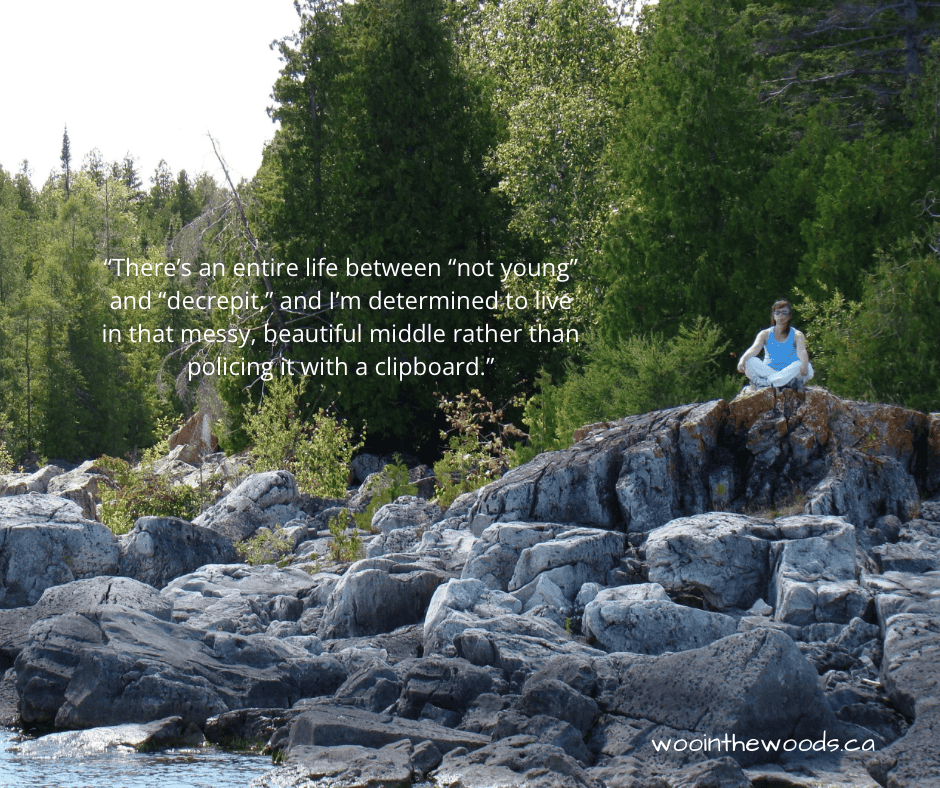
If there’s anything the last few years have taught me, it’s this: obsessing over avoiding the pitfalls of aging is a really tiring way to be young. Or, if not young, at least present. There’s an entire life between “not young” and “decrepit,” and I’m determined to live in that messy, beautiful middle rather than policing it with a clipboard.
Practical Shifts That Helped Me
Here are a few practical things I’ve found helpful when I catch myself looking for trouble:
- Name it. Say out loud: “I am looking for trouble right now.” Ridiculous and useful. It interrupts the loop because naming something gives it borders.
- Replace one worry with one delight. For example, for every five minutes spent reading doomscrolling health info, spend five minutes doing something that makes you feel good – watch Carol Burnett clips, call or text someone you love, or do a gentle stretch.
- Move in a way that feels nourishing. Not always hard, not always long. My new metric isn’t “how much I sweat” but “did my body and brain feel better afterward?”
- Trust the tests, consult a real person. If something concerning crops up, get it checked. But once the tests say you’re fine, treat that as data, not a dare to keep testing.
- Keep a “small wins” list. Tiny, silly, mundane things count. A great cup of tea. A cleared inbox. A workout session that didn’t suck. These are proof that life is happening and it’s mostly okay.
- Be kind to the parts of you that are scared. The menopause rollercoaster messes with a lot more than hormones; it tangles confidence, sleep, and sometimes the To-Do list. Be tender.
A Tiny Challenge for You
If you’re nodding along – whether sympathetically or because you can’t remember why you walked into the kitchen five minutes ago, picked up your phone and started reading – here’s a tiny challenge. For one week, whenever you feel the itch to Google a new symptom, pause and ask yourself: “What if I’m just looking for trouble?” Then, instead of diving down the rabbit hole, do one small thing that delights you. Make a ridiculous sandwich (pickle and peanut butter anyone?). Put on a song you danced to in your 20s and dance like the maniac you probably were. Step outside and breathe. It won’t fix everything (life is not a rom-com), but it will give your nervous system a break and, slowly, that tends to be where everything else gets nicer.
Final Word: Stop Auditioning for Anxiety
I haven’t cured menopause – it isn’t something to be cured. And I’m not pretending to have a blueprint. I have discovered just how powerful the mind can be. As a result, I’ve simply stopped auditioning for the role of the anxious narrator in my own life. I no longer want to be defined by a list of potential disasters. I want to be defined by how I show up to my days: with a body I love treating well, a brain I quiet sometimes with qigong, and a tendency to look for delight instead of difficulty.
So if you find me in a grocery lot, parking unnecessarily far from the door, doing a slow touch-down victory dance because I carried the bags without dying – just smile, wave and carry on. Maybe try it yourself. Who knows? You might catch yourself looking for trouble and discover, as I did, that trouble was mostly imaginary.
If you’ve ever gone down the Dr. Google/YouTube rabbit hole (no judgment, I’ve got tendonitis from all the scrolling), let me know in the comments or share this post so someone else feels a little less alone and low-grade future-fearful.
Recent Posts
By the time you’re reading this, January is well underway - almost done actually. The confetti has been swept up, the bold declarations have softened (or been forgotten), and whatever energy the...
DisclaimerI’m not a doctor, a psychologist, or a psychiatrist - just a curious explorer of this human experience. This post is simply my mind wandering and wondering, trying to figure things out....